

Industry
Design
PackRoute: Designed Trustworthy AI Experience In Procurement
Expected Product Impact
Accelerated sourcing decisions, reduced manual PO errors, and lowered AI procurement costs through pay-per-request micropayments and explainable recommendations.
Time
06 - 07 June 2026
Hackathon Organizer
Algorand
Tool
Cursor
Client
Algorand
My Team
1 Product Designer, 1 AI Engineer
Context
During a 2-day Algorand Agentic Commerce x402 hackathon, I co-designed an AI-assisted procurement interface focused on building trust, transparency, and user confidence in regulated cross-border transactions.
Business Problem & Goal
European SMEs and procurement teams spend significant time and cost managing sourcing and purchasing through spreadsheets and email-based workflows.
Constraints
Time
Only 2 days to finish building prototype with Algorand integrated and creating pitch slides and DEMO videos
Knowledge
Both my teammate and I are new in FinTech and Blockchain.
Technich
We must integrate Algorand into our product.
My Role
UX Designer
I guided UX improvements with the AI engineer to rapidly iterate the prototype, then used Claude Design to create the pitch deck and demo video within 2 hours.
AI Product Workflow= AI-assisted Design + Human Oversight
01 Define & Ideate
02 Design
03 Iteration
04 Created Pitch Slides & Demo video with Claude Design
Solution
PackRoute Agent
We built PackRoute AI agent that sources cross-border packaging suppliers, pays for intelligence via x402 micropayments on Algorand, and completes supplier checkout within owner-defined spending rules.
PackRoute Agent DEMO
Define & Ideation
Assumptions of User Pain points
No transparency into how suppliers are vetted
Users lack confidence in AI-driven decisions
Higher operational costs and increased procurement risk
Verification barriers slow adoption
Regulatory compliance is manual and error-prone
Problem Statement
European SMEs and procurement teams struggle to find reliable, compliant suppliers efficiently due to costly manual discovery, comparison, approval processes, and limited trust in AI agents.
How Might We
How might we make the AI agent assistant trustworthy for the procurement teams?
How might we help the procurement team find the reliable and compliant suppliers efficiently?
How might we help the procurement team lower operational costs for supplier discovery, comparison, approval process?
Design
UX Design Decisions Throughout User Flow
The user flow below shows design decisions we agreed on for the PackRoute Agent and the workflow of the Agent via Algorand x402 payment.
Scenario
Designing for transparent AI collaboration when the user opens the PackRoute agent dashboard:
Simple onboarding guidance by agent
Transaction status session card gives human oversight over full autonomy

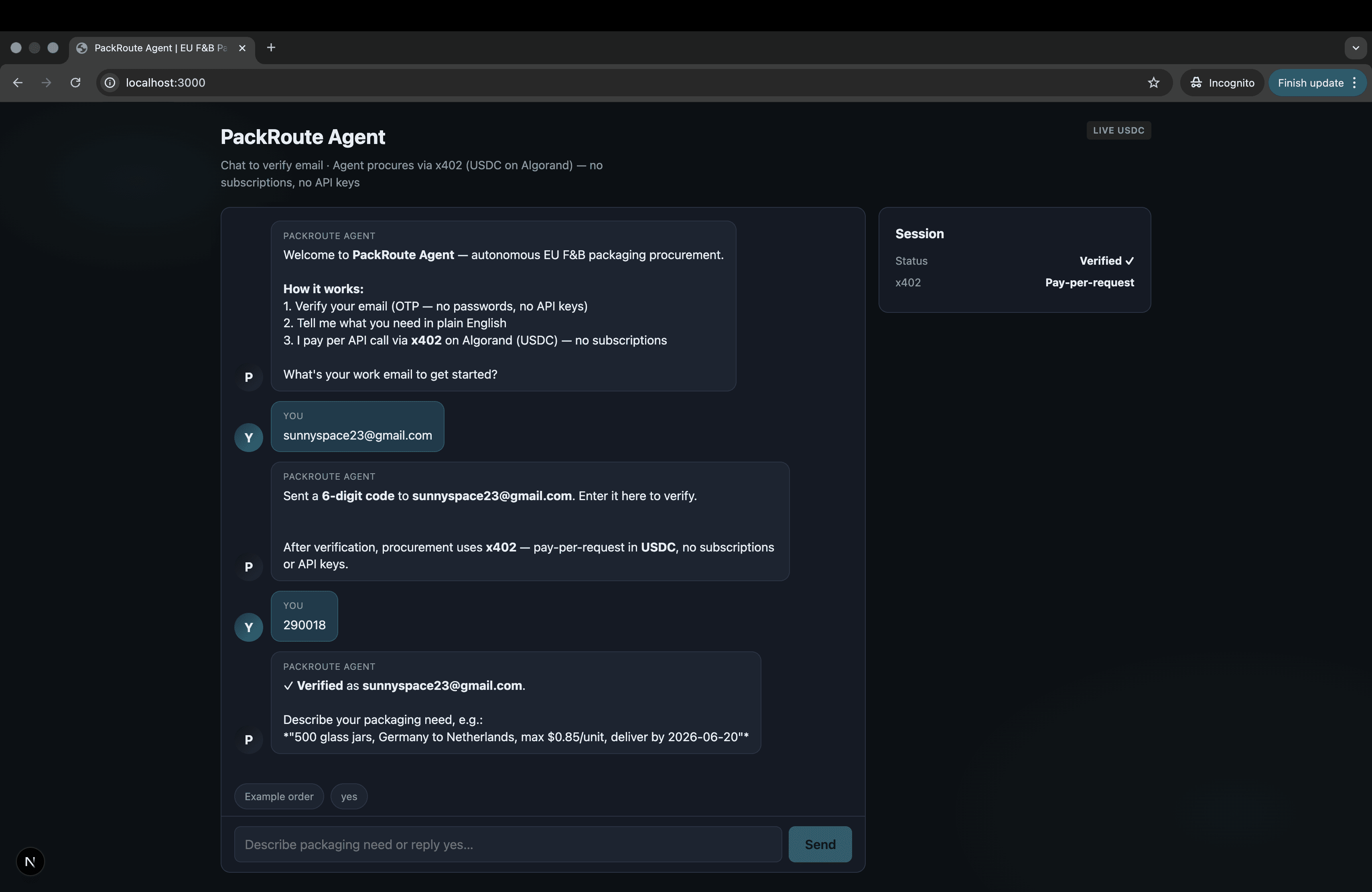
Easy identity verification for the user using customized sourcing service and micro-payment:
Security/permissions handling without passowrd and API keys
Progressive disclosure of procurement context helps users understand why the AI recommends a supplier before confirming.


AI transaction workflow with Algorand in the user's agent wallet.
Pays $0.01 USDC (x402) for packaging supplier price index
Pays $0.05 USDC (x402) for cross-border freight quotes
Compares landed cost and selects best supplier
Pays $0.10 USDC (x402) to confirm supplier checkout
AI-assisted transaction workflow with human guardrails
Rather than fully autonomous execution, PackRoute requires users to approve spending limits upfront and validate the final supplier selection.

Pitching the PackRoute Agent Product

Takeaways
01
Proactively communicating with the engineer about the working progress to give the helpful UX design advice on building the product with better UX.
02
Prioritizing simplifying the user flow to gain the user trust with AI agent decision and support
03
Understanding regulatory and security constraints is fundamental for trustworthy design.
Conclusion
Through building Agentic commerce product integrated with Algorand with AI engineer, I learned how to design the simple AI workflow for users in FinTech and Blockchain areas.
What I would do differently next time
Define a "Security & Trust Design System" and design principles upfrontfor communicating algorithmic decisions, handling permissions, showing compliance status
Conduct accessibility & compliance audits early by using WCAG and regulatory alignment as design inputs, not QA checkboxes
Validate user trust through testing, even in tight timelines (30-min user test for shipping faster)
Algorand Agentic Commerce x402 Hackathon Event Website on Luma
Prototype on Github
Pitch Slides on Github
Original Demo on Github